Last June, I made the sweetest iced coffee in human history.
It was my friend Maya’s birthday brunch one of those warm Saturday mornings where everything feels possible and everyone shows up ready to laugh. I’d volunteered to handle drinks, which felt easy enough. Cold brew concentrate, some simple syrup I’d made earlier that week, ice, done.
Except when I poured the first round, Maya took one sip and her face did that thing. You know the thing. The polite smile that doesn’t quite reach the eyes. The “this is… interesting” face. She didn’t say anything, but I saw her quietly add more cold brew to her glass when she thought I wasn’t looking.
I tasted mine. My teeth hurt. It was like drinking liquid candy with a coffee aftertaste.
The problem? I’d made my syrup wrong. Not bad just wrong for what I was using it for. I’d used equal parts sugar and water (a 1:1 ratio), which is perfectly fine for most things. But I’d used way too much of it because I didn’t understand that different ratios exist for different reasons. And honestly? I didn’t even know there were different ratios until that moment of collective tooth pain around my kitchen table.
That brunch became my crash course in simple syrup ratios. And now, almost a year later, I’ve made so many batches of both 1:1 and 2:1 syrup that I can tell you exactly when to use each one and why it actually matters.
This isn’t culinary algebra. It’s just two numbers that, once you understand them, transform how you sweeten everything from your morning iced tea to that fancy cocktail you’re trying to impress someone with. If you’re curious how these ratios connect to flavored syrups, check out our guide on blue curacao syrup and ratios.
Here’s what we’ll cover:
- What 1:1 and 2:1 actually mean (and why it’s simpler than it sounds)
- When to use each ratio based on real drinks, not abstract theory
- How to make both versions without overthinking it
- Storage tips I learned from throwing out spoiled syrup more times than I’d like to admit
- The emotional truth: why getting this right feels like a tiny act of care
My goal is simple: help you avoid serving accidentally-candy-flavored coffee to people you care about. And more than that help you feel confident sweetening anything without guessing.
Let’s talk about the two ratios that changed my kitchen and probably saved a few friendships.
What Grandma Dalida Taught Me About “Just Right”
Before I dive into the technical stuff, I need to tell you about something Grandma Dalida used to say when I’d help her in the kitchen as a kid.
She’d be making something tea, lemonade, a tonic with honey and herbs and I’d ask her how much sugar to add. She never measured. She’d just pour a little, taste, and say, “Not yet.” Pour a little more, taste again. “Almost.” One more pour. “There. That’s just right.”
I remember being frustrated because I wanted numbers. “But how much is it, Grandma?”
She’d smile and tap her chest. “You’ll know here. Too sweet makes you tired. Not sweet enough and you don’t want to finish it. Just right? You want another sip.”
At the time, I thought she was being deliberately vague. Now I realize she was teaching me something deeper than measurements: balance matters more than precision. The right amount of sweetness isn’t about following a rule it’s about paying attention to how something makes you feel.
That said, Grandma didn’t have to make iced coffee for twelve people on a Saturday morning. She didn’t batch-prep syrups for the week. She made one glass at a time, tasting as she went.
And that’s where understanding ratios becomes useful. Because once you know the baseline 1:1 for lighter sweetness, 2:1 for concentrated richness you can then adjust based on what your body (or your guests’ faces) tells you.
Grandma’s wisdom + actual measurements = drinks that taste intentional, not accidental.
Understanding 1:1 Simple Syrup (The Everyday Ratio)
After the Great Iced Coffee Disaster of last June, I did what any slightly embarrassed person does: I googled “simple syrup ratios” and fell down a rabbit hole.
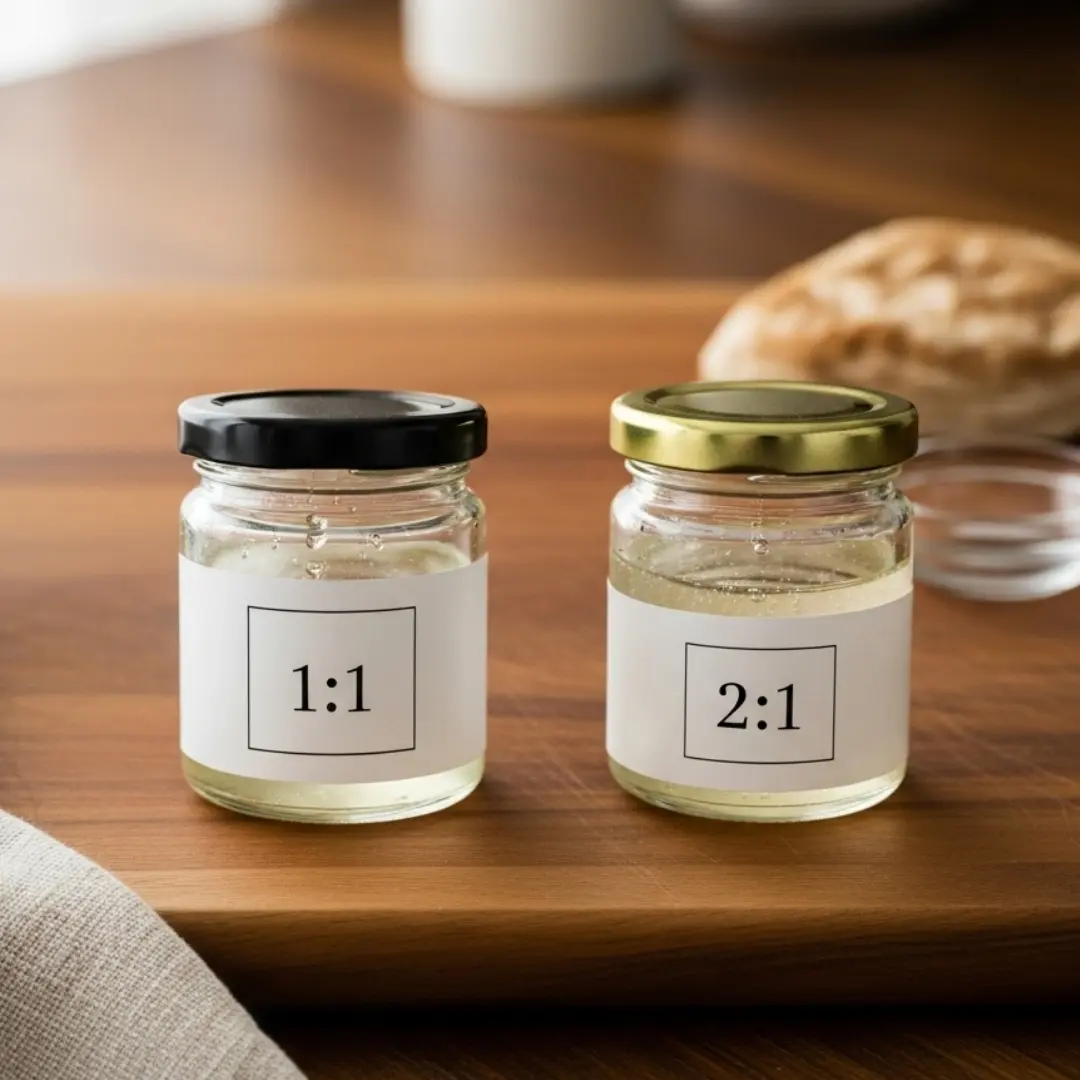
Turns out, when most people say “simple syrup,” they’re talking about a 1:1 ratio which just means equal parts sugar and equal parts water. One cup of sugar to one cup of water. Half a cup to half a cup. 125ml to 125ml if you want to make exactly 250ml.
It’s called “simple” for a reason. Two ingredients, one ratio, done.

This ratio is what I reach for most often now. It’s light, it dissolves easily in both hot and cold drinks, and it doesn’t overpower anything. It’s the syrup equivalent of a supportive friend there when you need it, but not making everything about itself.
How I Actually Make 1:1 Syrup
Here’s my process, which I’ve now done about fifty times since that brunch:
Grab a small saucepan. Nothing fancy I use the same one I make oatmeal in.
Measure equal amounts of sugar and water. I usually make 1 cup of each (which gives you about 1.5 cups of finished syrup because chemistry). If you want less, just scale down half cup of each, quarter cup of each, whatever works.
Warm it gently over medium heat. You don’t need to boil it. You’re not trying to cook the sugar, just dissolve it. Stir occasionally I usually use a wooden spoon and stir in slow circles while I’m waiting for my coffee to brew or checking my phone.
You’ll know it’s ready when the liquid goes from cloudy to clear. That’s the sugar fully dissolved. It takes maybe 3-5 minutes. Sometimes I turn off the heat a little early and just keep stirring the residual warmth finishes the job.
Let it cool completely before using it. Hot syrup in cold drinks = weird temperature chaos. I usually pour mine into a mason jar and stick it in the fridge while I do other things. It’s ready when it’s room temp or cooler.
That’s it. Seriously. The first time I made it correctly (post-brunch-disaster), I remember thinking, “Wait, this is all there is to it?”
When I Use 1:1 Syrup
This has become my default for:
Iced herbal teas where I want gentle sweetness that doesn’t compete with the herbs. I make a big pitcher of mint tea on Sunday nights and keep a jar of 1:1 syrup next to it so I can adjust each glass to my mood.
Lemonade and fruit-forward drinks where the natural tartness needs balance, not a sugar bomb. My friend Sarah makes strawberry lemonade with this ratio and it’s perfect you taste the fruit, not just sweetness.
Light cocktails or mocktails where you’re shaking citrus, herbs, and spirits together. Think mojitos, daiquiris, anything with lime. The 1:1 ratio blends in without taking over. If you’re making mocktails, you might also like our complete simple syrup tutorial with infusion ideas.
Morning tonics and wellness drinks when I want just a hint of sweetness to make something drinkable but not dessert-like. I add a teaspoon to my lemon-ginger water some mornings and it makes all the difference without making me feel like I started the day with candy.
The thing about 1:1 is that it’s forgiving. If you add a little too much, your drink is just slightly sweeter. It’s not a disaster. You can fix it with more liquid or ice or just accept that today’s iced tea is on the sweet side.
Is simple syrup 1:1 or 2:1?
It can be either, depending on what you’re making. A 1:1 ratio (equal sugar and water) is lighter and more versatile perfect for most drinks. A 2:1 ratio (twice as much sugar as water) is richer, thicker, and lasts longer in the fridge. Most people start with 1:1 and make 2:1 when they need something more concentrated.
Understanding 2:1 Simple Syrup (The Rich, Concentrated Version)
About a month after I figured out 1:1 syrup, I discovered why people bother making 2:1.
I’d been making cold brew every week the kind where you steep coarse coffee grounds overnight and end up with super concentrated, smooth coffee. But every time I’d add my 1:1 syrup, I’d need so much of it to get the sweetness right that my coffee would get watery. Not terrible, just… diluted. Like I was adding sweetened water instead of actual sweetness.
Then my friend David (who used to bartend) came over, saw what I was doing, and said, “Oh, you need rich syrup for that.”
“Rich syrup?”
“Yeah. 2:1 ratio. Twice as much sugar as water. Way more concentrated, so you use less and don’t water down your drink.”
He was right. The first time I made cold brew with 2:1 syrup, I used maybe a tablespoon instead of the quarter cup I’d been drowning it in before. The coffee stayed strong, the sweetness was there, and nothing got diluted.
That’s when I understood: 2:1 isn’t just “more sugar.” It’s concentrated sweetness that does its job without changing the texture or strength of what you’re adding it to.
How to Make 2:1 Syrup
The process is almost identical to 1:1, with one key difference: you’re dissolving a lot more sugar.
Use twice as much sugar as water. So if you’re using 1 cup of water, you need 2 cups of sugar. If you want to make exactly 250ml, use about 166ml of sugar and 83ml of water (I usually eyeball it slightly more sugar than half the water amount).
Warm it gently and stir more often. Because there’s so much sugar, it takes longer to dissolve. I keep the heat on medium-low and stir pretty constantly. If you walk away, you might end up with a layer of undissolved sugar on the bottom. Ask me how I know.
Be patient. This one can take 7-10 minutes to fully dissolve. You’ll know it’s ready when the liquid is completely clear and there’s no graininess when you drag your spoon along the bottom of the pan.
Let it cool, then store it in a clean jar. Same as 1:1. I use mason jars and label them with the ratio and the date because three weeks from now, I will not remember which is which.
The finished syrup is noticeably thicker than 1:1. It coats a spoon. It drizzles slowly. It feels almost honey-like, but still pourable.
When I Use 2:1 Syrup
Once I had both ratios in my fridge, I started noticing when each one worked better:
Cold brew and iced coffee always 2:1 now. It dissolves easily even in cold liquid (which is kind of magic), and I use so little that my coffee stays coffee-strength.
Spirit-forward cocktails like Old Fashioneds or Manhattans where you don’t want to add extra liquid. David explained this to me: in a cocktail that’s mostly whiskey or bourbon, even a little extra water changes the whole balance. 2:1 gives you sweetness without dilution.
Batch-prepping drinks for gatherings because 2:1 lasts longer in the fridge. The higher sugar content acts as a preservative I’ve kept 2:1 syrup for over a month and it stayed perfectly clear and fresh. My 1:1 syrup starts looking questionable after about three weeks.
Any time I want sweetness but need to control the amount of liquid I’m adding. Like when I’m making a glaze or drizzle, or when I want to sweeten something that’s already the right consistency and I don’t want to thin it out.
The downside? If you accidentally use too much 2:1, your drink crosses the line from sweet to sweet pretty fast. It’s less forgiving than 1:1. But once you get a feel for it usually a tablespoon or two is plenty it becomes your secret weapon.
When to Use 1:1 vs 2:1: Real Drinks, Real Differences
Okay, so you understand what the ratios are. But here’s the question that actually matters: which one do you reach for when?
I’m going to walk you through this the way I actually think about it now not as abstract categories, but as specific drinks I make and moments when one ratio clearly works better than the other.
For Cocktails and Mocktails
Use 1:1 when you’re shaking citrus or making anything light and refreshing. Think mojitos, margaritas, daiquiris, lemonade spritzers. These drinks benefit from the extra liquid it helps dilute and blend all the flavors together. Plus, when you shake a cocktail with ice, you want some dilution. That’s part of the texture.
Last month I made mint mojito mocktails for a friend’s baby shower (we used our blueberry mocktail technique but with mint and lime). I used 1:1 syrup, and the drinks were bright, balanced, and exactly the right level of sweet. If I’d used 2:1, I would’ve needed so little syrup that measuring it would’ve been annoying, and the drinks might’ve skewed too tart.
Use 2:1 when you’re stirring spirits or making something strong and spirit-forward. Old Fashioneds, Manhattans, Negronis drinks where the base is whiskey, bourbon, or another intense spirit. These don’t get shaken with ice. They get stirred, which means less dilution. And you want the syrup to sweeten without adding noticeable liquid.
David taught me this rule: if you’re shaking it, use 1:1. If you’re stirring it, use 2:1.
For Iced Coffee and Tea
This is where I learned the difference through trial and error (mostly error).
Use 1:1 for light, herbal iced teas. Mint tea, chamomile, fruit infusions anything where the flavor is delicate and you want to add just a hint of sweetness without covering it up. I make a big pitcher of iced mint tea every week and keep 1:1 syrup next to it. A teaspoon per glass is usually perfect.
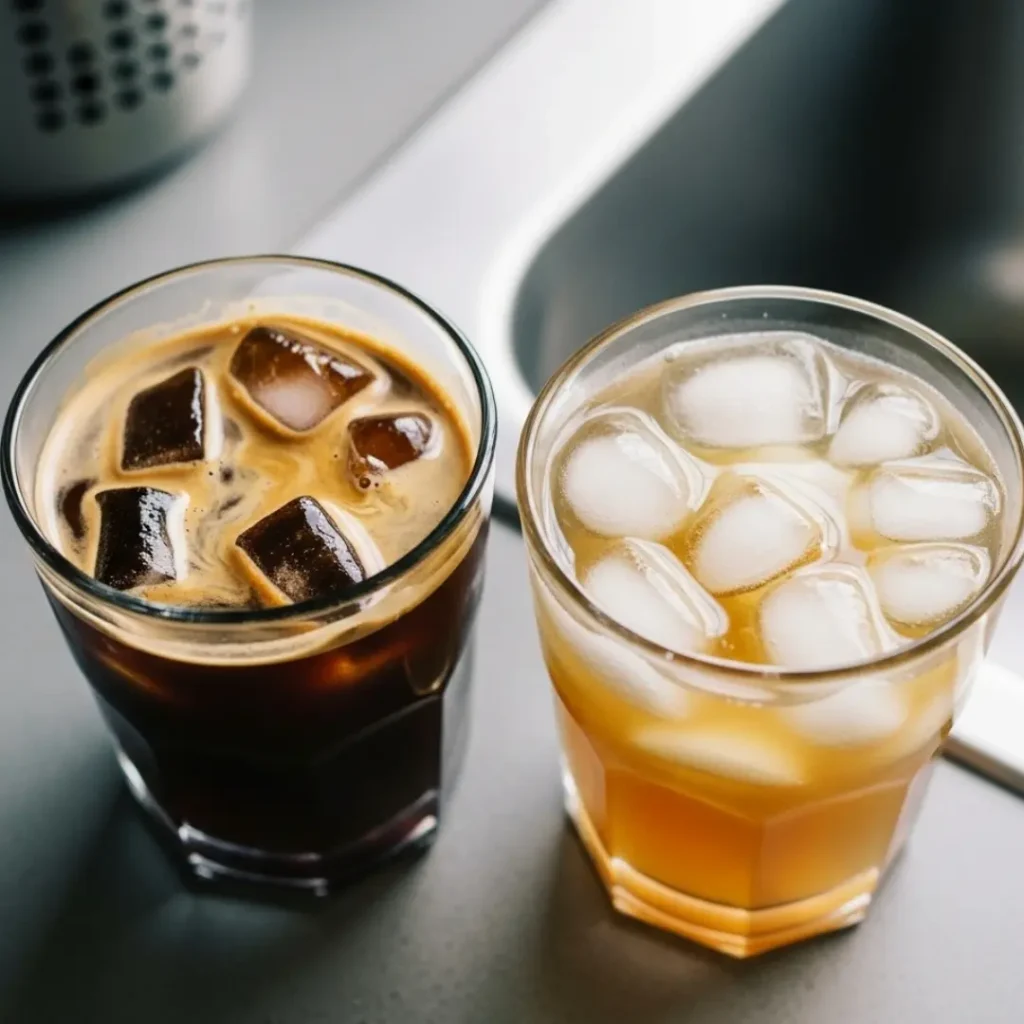
Use 2:1 for iced coffee and cold brew. This was the game-changer for me. Cold brew is so concentrated that it needs serious sweetness to balance the intensity. But if you add a bunch of 1:1 syrup, you’re basically adding sugar water and thinning out the coffee. With 2:1, a single tablespoon does the job without changing the strength or texture at all.
I also use 2:1 when I’m batch-prepping iced coffee for the week. I make a big jar on Sunday, add the syrup directly to the concentrate, and then just pour over ice each morning. It stays strong, stays sweet, stays perfect.
For Everything Else
Honestly, once you have both ratios in your fridge, you start finding uses for them everywhere:
Morning wellness drinks: I use 1:1 in my lemon-ginger water because I want it just barely sweet more like a tonic than a treat.
Overnight oats: Sometimes I drizzle a little 2:1 syrup into my oats instead of honey. It distributes more evenly and I can control the sweetness better.
Fruit salads or yogurt bowls: A tiny drizzle of 1:1 syrup can bring out the natural sweetness in fruit without making it taste candied.
Glazes or drizzles for baked goods: 2:1 works better here because it’s thick enough to coat things without sliding off.
The more you use both, the more intuitive it becomes. You stop thinking “which ratio?” and start just knowing which jar to grab.
How do you make 250ml of simple syrup?
For a 1:1 ratio: mix 125ml sugar with 125ml water. For a 2:1 ratio: use about 166ml sugar with 83ml water. Combine in a saucepan, warm gently while stirring until the sugar dissolves completely, then let it cool. Store in a clean jar in the fridge. The 1:1 version is easier to measure; the 2:1 takes a bit longer to dissolve but gives you more concentrated sweetness.
Storage, Shelf Life, and the Lessons I Learned the Hard Way
Let me tell you about the time I discovered moldy syrup.
It was about two months into my syrup-making journey. I’d made a jar of 1:1 syrup, used it a few times, and then… forgot about it. It sat in the back of my fridge for probably five weeks. When I finally pulled it out to use in iced tea, I noticed these tiny white floaty things. Not bubbles. Not sugar crystals. Things.
I poured it down the sink and learned some important lessons about storage.
How to Store Simple Syrup Properly
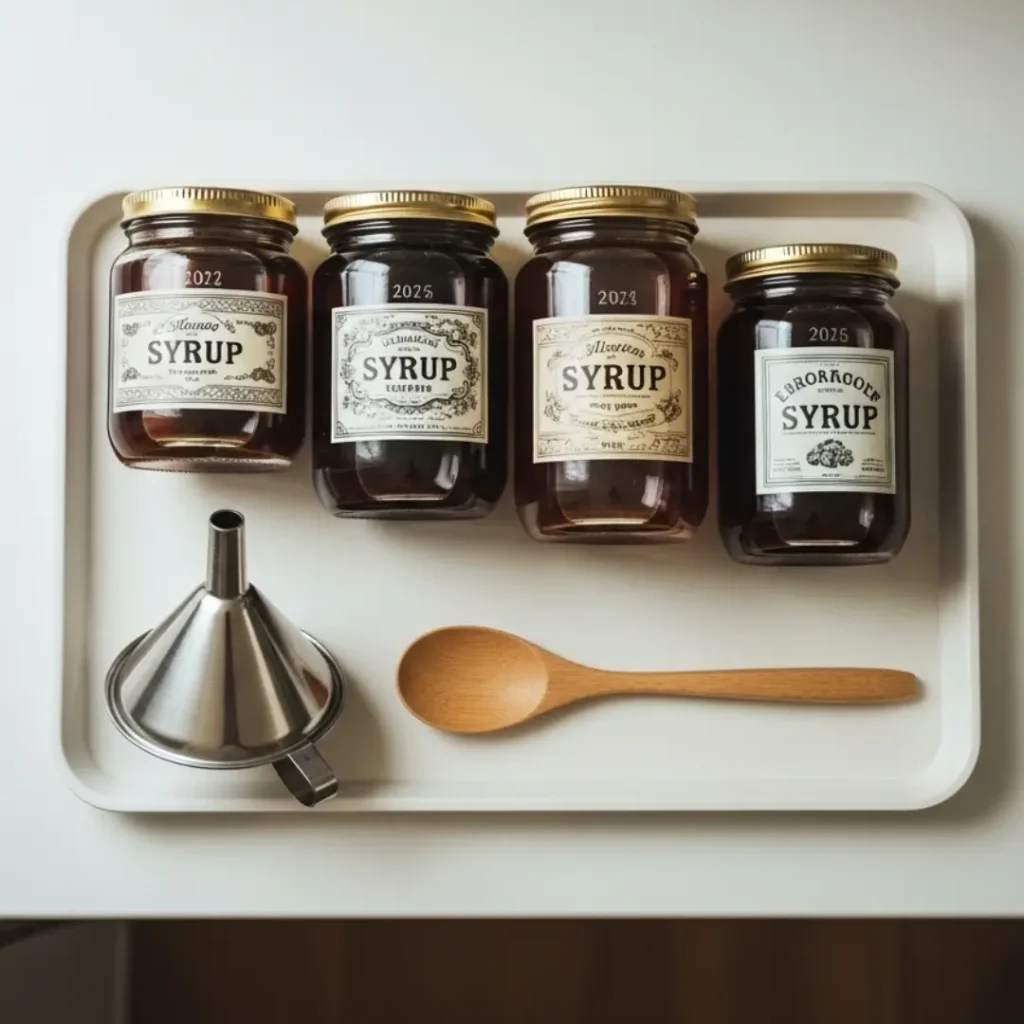
Use glass jars with tight-sealing lids. I use mason jars because they’re easy to sterilize and I can see the syrup clearly through the glass. Plastic works too, but glass feels cleaner and doesn’t absorb odors.
Always label with the date and ratio. I cannot emphasize this enough. Future-you will not remember which jar is which or when you made it. I write directly on masking tape with a Sharpie: “1:1 Oct 3” or “2:1 Oct 10.” It takes five seconds and saves so much confusion.
Store in the fridge, always. Room temperature syrup doesn’t last. The fridge slows down any bacterial growth and keeps your syrup fresh and clear.
Keep everything clean. If you’re reaching into the jar with a spoon, make sure it’s clean. If you double-dip (like using the same spoon you just stirred your coffee with), you’re introducing bacteria. I’ve started just pouring syrup directly from the jar instead of using a spoon less contamination risk.
How Long Does Each Ratio Last?
Here’s what I’ve learned through actual experience (and one unfortunate moldy incident):
1:1 syrup lasts about 3-4 weeks in the fridge. Sometimes I push it to four weeks if it still looks and smells fine. After that, I start getting suspicious and usually just make a fresh batch.
2:1 syrup lasts 4-6 weeks, sometimes longer. The higher sugar concentration acts as a natural preservative. I’ve had 2:1 syrup last over a month without any issues. It’s one of the reasons I default to 2:1 if I’m making a big batch for the week.
Signs your syrup has gone bad: Cloudiness (it should be crystal clear), visible mold or floaty bits, any off smell (it should just smell sweet), or a fermented/yeasty taste. If you notice any of these trust me just toss it and make fresh. It takes five minutes and it’s not worth the risk.
My Current System
I keep one jar of each ratio in my fridge at all times now. When I notice one getting low, I make a fresh batch before I run out completely. It’s become part of my Sunday meal-prep routine right after I make my overnight oats and portion out snacks, I check my syrup situation.
Having both ratios ready means I never have to think twice when I’m making a drink. I just open the fridge, grab the right jar, and go. It’s one of those tiny systems that makes daily life feel smoother.
What is the ratio of sugar to simple syrup?
The most common ratio is 1:1 equal parts sugar and water by volume. This gives you a standard simple syrup that works for most drinks. The other popular ratio is 2:1 twice as much sugar as water which creates a richer, more concentrated syrup. Both are considered ‘simple syrup’; the ratio you choose depends on how you plan to use it and how long you want it to last.
Why Getting This Right Actually Matters
Here’s the thing about simple syrup ratios: on the surface, it seems like such a small, almost trivial detail. Sugar and water. Two numbers. Who cares?
But I’ve come to realize that understanding these ratios is actually about something bigger than sweetness. It’s about knowing how to care for the things you make and by extension, care for yourself and the people you’re making them for.
That morning after Maya’s birthday brunch, when I finally understood why my iced coffee had been too sweet, I felt this weird mix of embarrassment and relief. Embarrassed that I’d served everyone liquid candy. But relieved that there was an answer a simple, fixable reason it went wrong.
Since then, I’ve made probably a hundred batches of syrup. Sometimes 1:1, sometimes 2:1, sometimes flavored with herbs or citrus peels. And every time I make it, I think about Grandma Dalida’s “just right” philosophy.
Because here’s what I’ve learned: Getting the ratio right isn’t about perfection. It’s about intention. It’s about paying enough attention to understand what something needs whether that’s your cold brew, your friend’s mojito, or your own morning lemon water.
When you make your own syrup instead of buying it, you’re making a small choice in favor of control, quality, and care. You’re saying: I want to know what goes into this. I want it to taste exactly how I want it to taste. I want to be able to adjust it to fit my life.
And when you understand the difference between 1:1 and 2:1 when you can reach for the right jar without thinking you’ve developed a kind of quiet competence. You’re no longer guessing. You’re knowing.
That knowledge transforms ordinary moments. Your iced coffee tastes right. Your cocktails feel intentional. Your morning wellness drink is exactly as sweet as you need it to be no more, no less.
And maybe this sounds overly sentimental about sugar water. But I think these small acts of care the ones that take five minutes and make daily life feel more considered are actually what self-care looks like in practice. Not bubble baths and face masks (though those are great too). Just knowing how to make something properly, and then doing it.
Your Simple Syrup Journey Starts Here
So here’s what I want you to do this week: make one jar of simple syrup. It doesn’t matter which ratio. Maybe 1:1 if you want something versatile. Maybe 2:1 if you’re a cold brew person.
Measure your sugar and water. Warm them gently. Stir until everything dissolves and goes clear. Pour it into a clean jar. Label it with today’s date and the ratio.
Then put it in your fridge and use it every day for a week. Add it to your coffee, your tea, your lemonade, whatever. Notice what happens. Notice how much you use. Notice how it makes things taste.
At the end of the week, you’ll know whether that ratio worked for you. And if it didn’t if your drinks were too sweet or not sweet enough or you ran out too fast or you wanted something thicker make the other ratio next.
That’s how you figure this out. Not by reading about ratios (though I hope this helped), but by using them. By paying attention. By adjusting. By finding your own version of “just right.”
And maybe, like me, you’ll end up keeping both ratios in your fridge at all times. One for the light, refreshing moments. One for the rich, concentrated ones. Both ready whenever you need them.
You’ve got this. Syrup might be simple but when it’s made with intention and understanding, it transforms everything it touches.
Want more kitchen confidence? Come hang out with me in the Golden Era Recipes community. I share daily tips, family wisdom, and the kind of simple techniques that make cooking feel easier not harder. Let’s make your mornings (and your iced coffee) better together.
👉 Follow Golden Era Recipes on Facebook
🩷 A Note from Olivia:
This syrup guide comes from years of making (and occasionally ruining) drinks in my Nashville kitchen. It’s based on personal experience and what I’ve learned works for me not medical or nutritional advice. Adjust sweetness to fit your taste and lifestyle. And remember: there’s no “perfect” ratio, only the one that makes your drinks taste right.